A policy analysis on India’s AI compute strategy, dependency risks, and pathways to technological sovereignty.
Executive Summary
- India’s rapid progress in artificial intelligence is built on compute infrastructure it does not control.
- This creates a structural dependency that may constrain long-term capability.
- This paper proposes a layered —“Sovereign Stack+” strategy
This paper is part of a broader series on AI governance and strategic technology policy.
India is moving quickly to build artificial intelligence capability. Subsidised access to compute infrastructure has enabled startups, researchers, and enterprises to experiment, build, and scale.
In the short term, this works.
Models get trained. Products get launched. The ecosystem shows visible momentum.
The Structural Constraint
But beneath this progress lies a structural issue that is easy to overlook.
India is building its AI capability on infrastructure it does not control.
A single firm dominates the global market for advanced AI GPUs. The software ecosystem used to program these systems is tightly coupled to that hardware. The fabrication supply chain is concentrated in a few geographies. Access to cutting-edge systems is governed by export control regimes outside India’s influence.
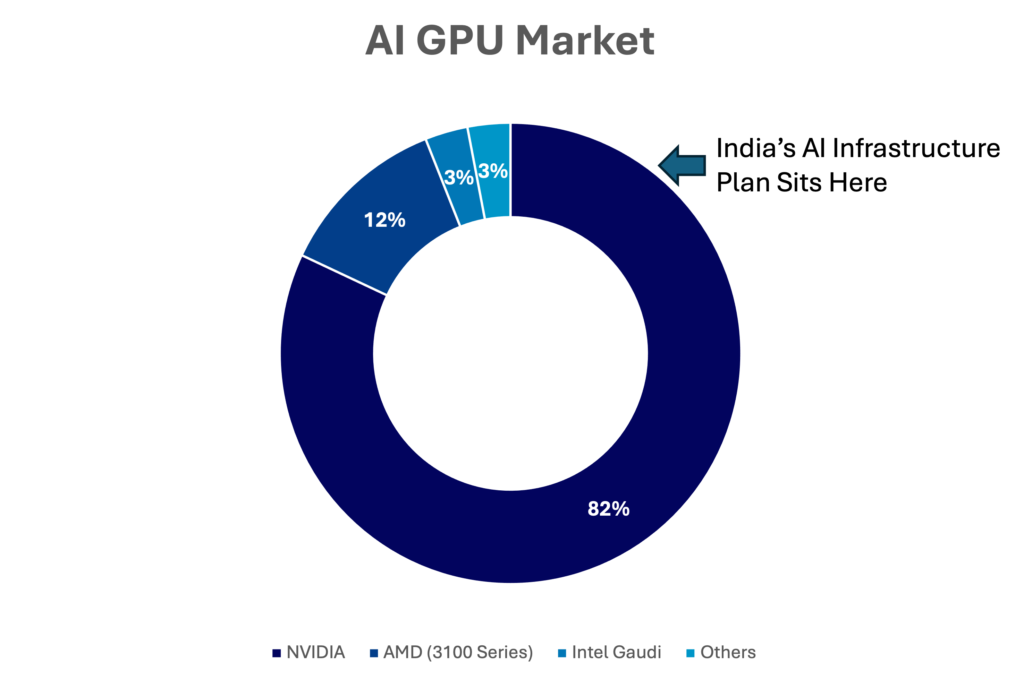
This is not just a technical detail. It is a strategic constraint.
India’s AI growth today depends on systems that can, under certain conditions, become unavailable, unaffordable, or restricted.
The question is no longer whether India can build AI applications. It clearly can.
The real question is whether India can sustain and scale its AI capability without being dependent on external decisions.
The Problem Beneath the Problem
At first glance, this looks like a procurement issue.
Should India buy more GPUs? From whom? At what cost?
But this framing is incomplete.
The deeper issue is not hardware. It is control.
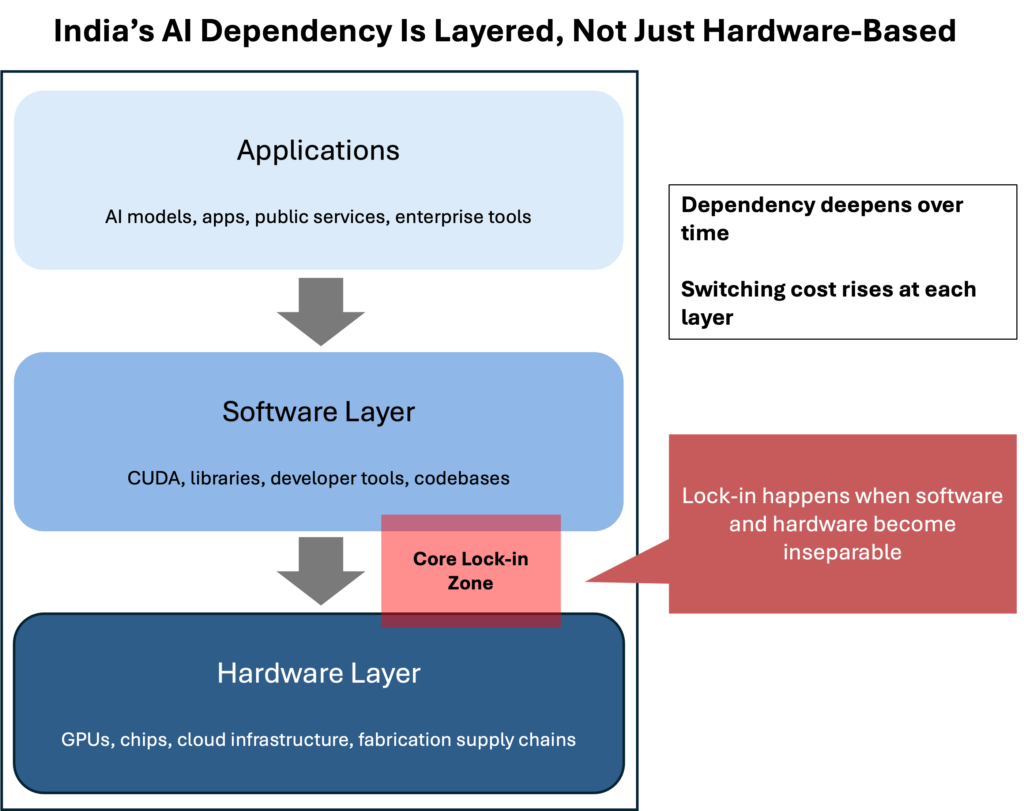
India is embedding its AI ecosystem into a stack that combines proprietary hardware, proprietary software, and globally controlled supply chains. Over time, this creates lock-in.
The most underestimated part of this lock-in is not the hardware. It is the software ecosystem.
Once developers, institutions, and companies build their systems around a dominant programming framework, switching becomes extremely difficult. Skills, codebases, and tools all align around that environment.
At that point, even if alternative hardware exists, moving away becomes slow, expensive, and disruptive.
This is how dependency becomes permanent.
What looks like a short-term efficiency decision becomes a long-term structural constraint.
Why this Matters Now
If this dependency were purely commercial, it would still be manageable.
But AI infrastructure is no longer just a commercial asset. It is strategic.
AI systems are increasingly linked to economic competitiveness, public service delivery, defence capability, and information systems. This makes compute infrastructure a form of critical infrastructure.
At the same time, global technology flows are becoming more regulated.
Export controls, licensing regimes, and national security considerations are shaping access to advanced technologies. These are not hypothetical risks. They are already visible across multiple sectors.
India does not control these levers.
This creates a situation where a large part of India’s future AI capability depends on decisions taken outside its jurisdiction.
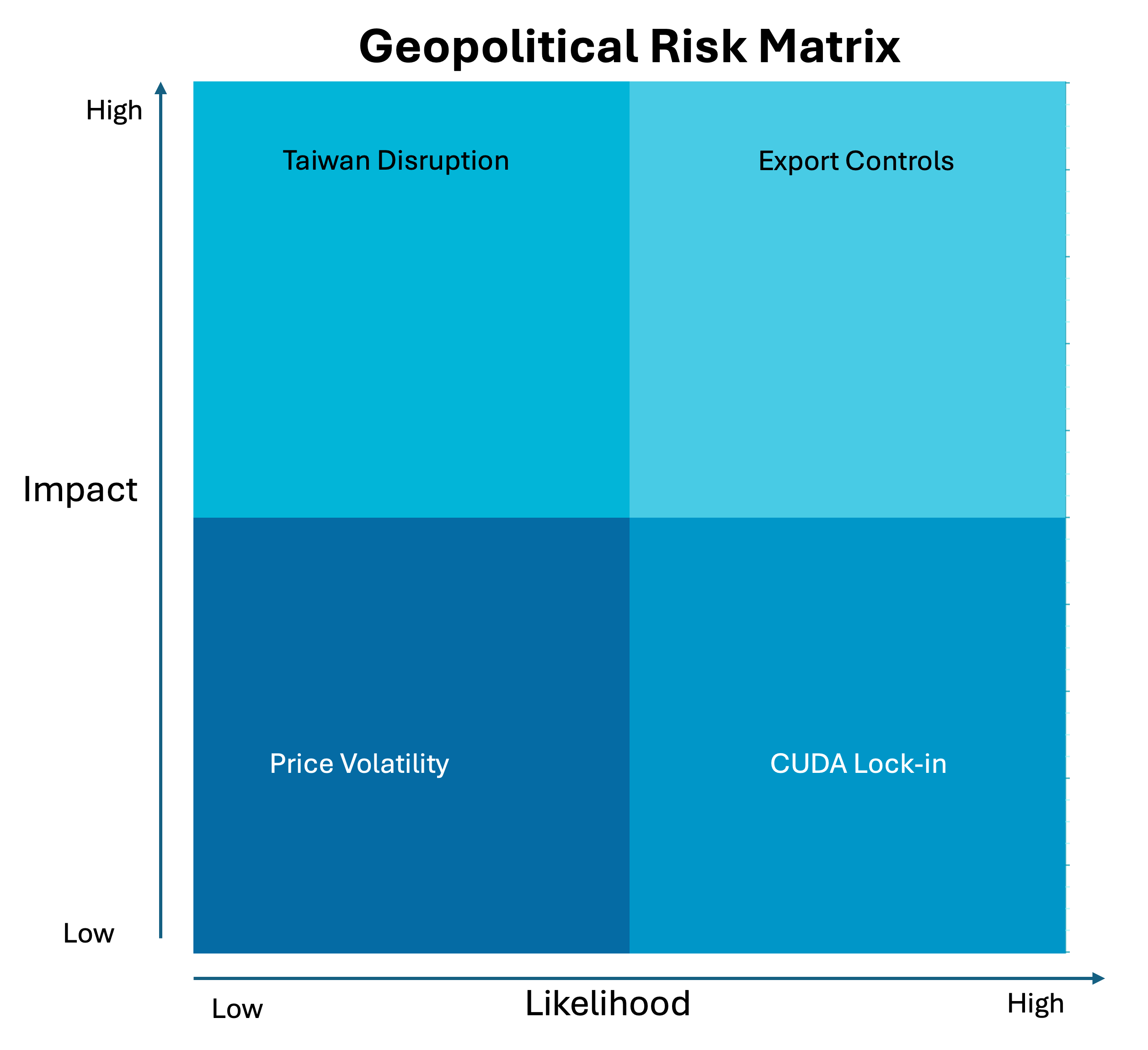
That is the core problem.
What Policy Needs to Achieve
Once the problem is understood correctly, the policy objectives become clearer.
India must continue to build AI capability at speed. Slowing down is not an option.
At the same time, it must reduce its dependence on a single compute ecosystem.
It must avoid deep lock-in to proprietary software frameworks.
It must create a credible pathway for domestic capability, not just as research but as usable infrastructure.
It must ensure that access to compute is not concentrated among a small set of actors.
And it must retain flexibility in case geopolitical conditions change.
These objectives cannot be achieved through a single intervention.
They require a coordinated approach.
The Strategic Options
There are several ways India can respond to this challenge.
- One option is to continue the current approach. This maximises short-term gains but leaves long-term risks unaddressed.
- Another is to diversify procurement. This reduces dependency but does not eliminate it, especially if the software layer remains unchanged.
- A third approach is to build domestic hardware capability. This is necessary but slow, expensive, and uncertain.
- A fourth approach is to work with like-minded countries to co-develop alternatives. This spreads cost and risk but requires coordination and political commitment.
- A fifth approach focuses on algorithmic efficiency. If AI systems can achieve the same outcomes with significantly less compute, dependence on high-end hardware reduces naturally.
- A sixth approach looks at entirely new computing paradigms. This offers long-term upside but comes with high uncertainty.
Each of these approaches addresses part of the problem.
None of them, on their own, is sufficient.
A Practical Way Forward: The Sovereign Stack+
A layered strategy to balance immediate access with long-term control.
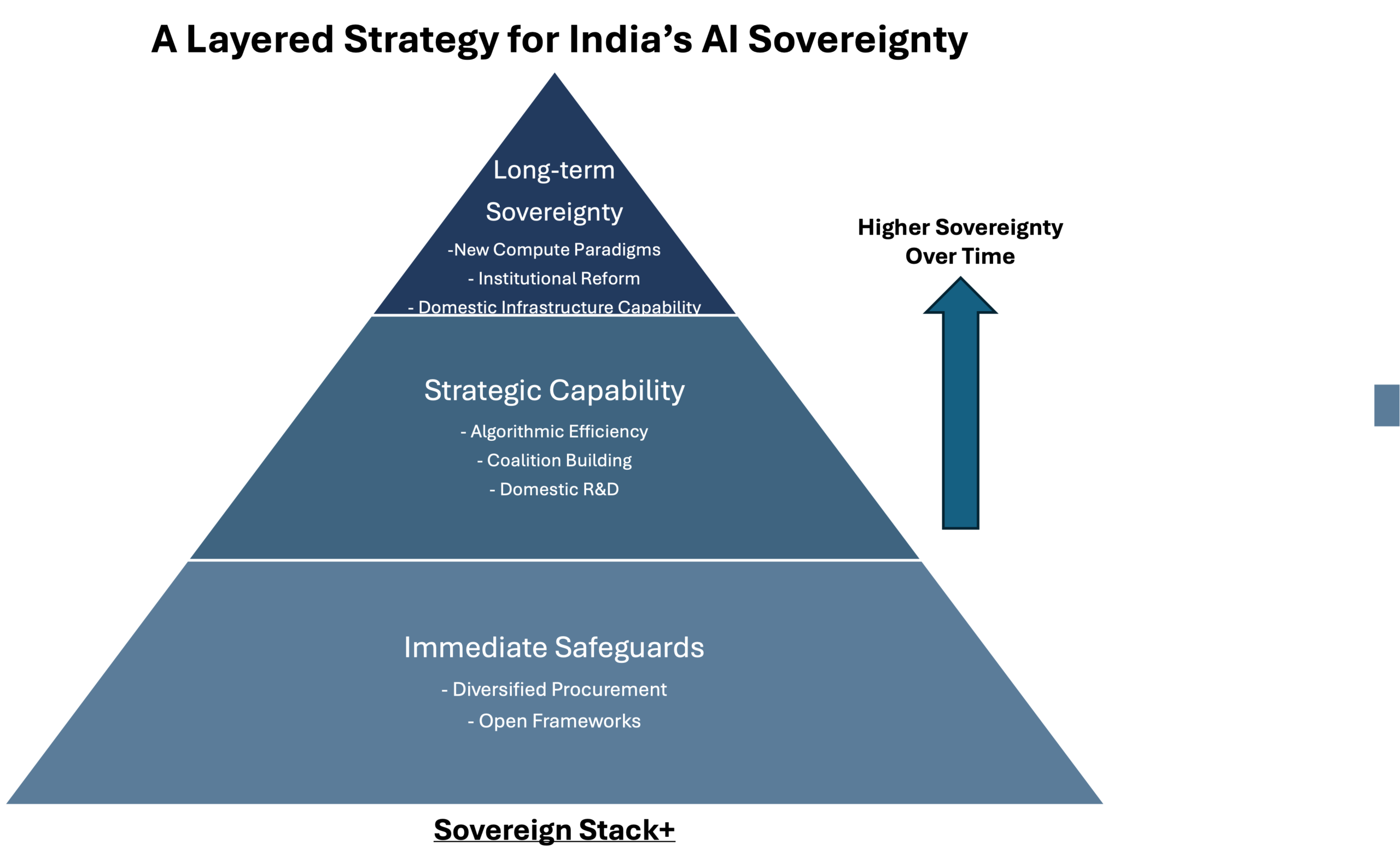
The most viable path is not to choose one approach, but to combine the most practical elements into a coherent strategy.
This can be thought of as a layered approach.
At the base level, India needs immediate safeguards.
This includes diversifying procurement to avoid single-source dependency and ensuring that publicly funded AI systems use hardware-agnostic software frameworks. These steps are relatively low-cost and preserve future flexibility.
At the next level, India must build structural advantage.
Two areas stand out.
The first is algorithmic efficiency. India has strong capabilities in mathematics and computer science. Investing in research that reduces compute requirements can significantly weaken hardware dependency over time.
The second is strategic collaboration. Partnering with countries that share similar concerns can accelerate the development of alternative ecosystems. No single country needs to bear the full cost.
At the top level, India must invest in long-term capability.
This includes domestic hardware development, targeted research into new computing paradigms, and institutional reforms that enable faster execution.
These are not short-term solutions. They are long-term bets that create optionality.
Together, these layers form a “Sovereign Stack+” strategy.
It balances immediate needs with future resilience.
The Role of Institutions
A recurring challenge across all strategies is execution.
India does not lack talent or capital. What it often lacks is the ability to execute complex, long-term programmes at speed.
Traditional administrative structures are not always suited for this.
Large, multi-year initiatives require clear accountability, operational autonomy, and the ability to attract and retain specialised talent.
Without this, even well-designed policies risk slow implementation and diluted impact.
Institutional design, therefore, is not a side issue. It is central to success.
Trade-offs That Cannot Be Avoided
Any shift in strategy will involve trade-offs.
Diversifying procurement may increase costs in the short term.
Moving away from dominant software frameworks may slow developers initially.
Investing in domestic capability requires patience, with results that may take years.
Building international coalitions requires sustained diplomatic effort.
Research-led approaches carry uncertainty.
These are real costs.
But they must be evaluated against the alternative.
A continuation of the current trajectory creates a system that is efficient but fragile. It performs well under stable conditions but lacks resilience when conditions change.
The goal is not to eliminate risk entirely. It is to ensure that India retains meaningful choices in the future.
The Direction Ahead
India’s current approach to AI compute has delivered access.
The next phase must focus on control.
This does not mean rejecting global technology. It means engaging with it on terms that preserve flexibility and build domestic strength over time. The transition will not happen overnight.
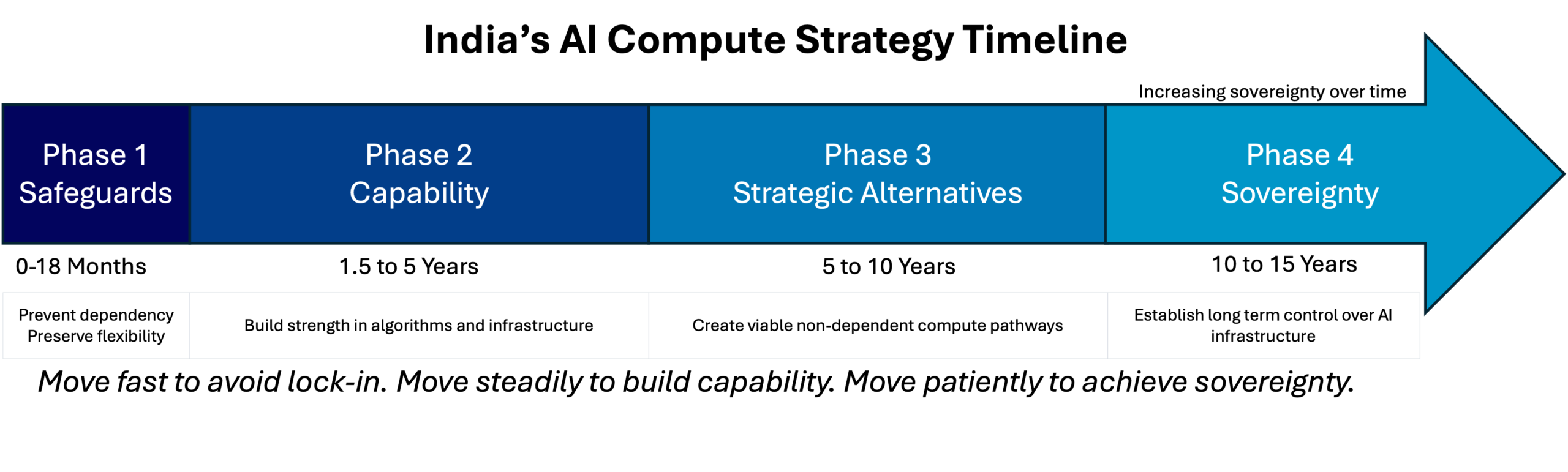
It will require deliberate policy choices, sustained investment, and institutional clarity.
But the window for making these choices is not unlimited.
Each additional layer of dependency makes change harder.
The decisions taken now will shape not just how India uses AI, but how much control it has over its own technological future.
India has already entered the AI era.
The question now is whether it participates on borrowed infrastructure, or begins to shape the foundations itself.
Final Line
India’s AI compute challenge is not a hardware problem.
It is a sovereignty problem expressed through infrastructure.